
Authentic Leadership Communication: Going Unscrubbed.

What a White House Summit, a Congressman with a conscience, and thirty years of watching brilliant women go quiet taught me about the radical act of asking for what you've already earned.
I want to tell you about the moment I stood up when I wasn't supposed to.
Not because it was heroic. It wasn't. My legs were shaking so hard I could barely walk to the microphone. My palms were sweating. My heart was pounding in a way that made it difficult to think clearly. I was 28 years old, I had gotten off a train from Boston at 3am, I had no money, and I was wearing the best blazer I owned (which was not very good).
And I had not been invited to speak.
I was sitting in the audience of the first White House Summit on Hunger in thirty years. A room full of the most powerful people in the country, gathered to figure out how to end hunger in America. The dais was full of white men. One woman. And Mike Espy, the Secretary of Agriculture and the only person of color on the dais.
I was the director of the National Student Campaign Against Hunger and Homelessness. We had organized 600 college campuses across the country. Students were doing the work these men were describing: collecting food, running drives, mobilizing communities, building infrastructure and nobody in that room knew we existed.
Every time someone at that dais said "here's what we need" I thought: we're already doing that. We've been doing that. And no one is saying it. My heart started pounding harder.
And then I stood up.
I walked to the audience microphone. I introduced myself. I told them who we were and what we were doing. I held up the research we had compiled, on a grassroots budget, with student volunteers, on no sleep, and I said:
This is already happening. Students across this country are already doing this work. You need to know we exist.
The room shifted.
What happened next changed my life. But I'll get to that.
WHY I'M TELLING YOU THIS NOW
I published the first story in The Unscrubbed Series two weeks ago in my bi-weekly LinkedIn Newsletter. It was a story about a client — a brilliant, accomplished woman in the federal government — who was told by a political appointee to stop speaking up in meetings. Because she was embarrassing him. Because she knew more than he did.
She complied. For a while.
The response to that piece was unlike anything I've experienced in twenty-five years of this work. Women from every industry: energy, healthcare, technology, finance, law, all saying the same thing: me too. This happened to me. I recognize this.
I've been thinking about why that piece landed the way it did. And I keep coming back to the same answer.
Because what's happening right now — the systematic silencing, the permission slips handed to people who were never qualified to issue them, the quiet institutional erasure of women from the rooms where decisions get made — isn't new. It's old. It's as old as every room I've ever walked into where the dais was full of white men and one woman and I was sitting in the audience wondering whether I had the right to say the thing that needed to be said.
What's new is that it's happening out loud now. In the open. Without apology.
And I think that calls for a response that's equally out loud. Equally open. Equally unapologetic.
So I'm going to tell you my story. All of it.
THE PEOPLE CLOSEST TO THE PROBLEM
I have a master's degree in political campaign management. I studied grassroots movements, how they start, how they sustain, how they change things. And the pattern is always the same.
The tide turns when the people directly impacted by the problem begin speaking out.
Look at the environmental movement. It didn't shift until Rachel Carson wrote Silent Spring and refused to be quiet about what she was seeing. Look at the end of the Vietnam War. Public opinion didn't turn until the veterans themselves began to protest. Not pundits. Not politicians. The people who had lived it.
Students have always been on the forefront of every social movement. We see what's happening up close. We are unencumbered by the institutional caution that keeps people in power from saying what's true.
But seeing the problem and actually solving it are two different things. And you only get to the solution when you ask the people experiencing the problem what they actually need.
That insight led me to create something called Project Partnership.
At the time, most student hunger and homelessness campaigns were running the same programs year after year. Sock drives, coat drives, canned food collections. Not because they weren't caring. Because nobody had stopped to ask the people experiencing hunger and homelessness what would actually help them.
I thought that was short-sighted. So I designed a program that required students to do three things before launching any initiative: go directly into the local community and ask the people experiencing hunger and homelessness what they needed, talk to the local service providers about what was already being offered, and only then design something that filled a real gap rather than a perceived one.
My boss told me I was being too radical.
I applied for our first ever grant anyway. $40,000 from VISTA. I was making $19,000 a year at the time. It felt like everything.
We tested it. It worked.
One of our key campuses had pre-law students sit down with people who needed identification documents to access benefits and help them actually get those documents. Not a sock drive. A direct, immediate, life-changing intervention that came entirely from asking the people affected what they needed.
A couple of years later my boss didn't just come around, she made community partnership the national standard. Today the National Student Campaign Against Hunger and Homelessness will only work with campuses that are in genuine partnership with the local communities and the people directly impacted by the issues.
What was called radical became the requirement. Because it was right.
I am telling you this because it is the same story I keep watching play out everywhere I look.
The women being silenced right now, in federal agencies, in boardrooms, in hospitals and law firms and technology companies, are not peripheral to the work. They are the connective tissue. They are the ones who understand the problems those institutions exist to solve. They are the ones closest to the people those institutions are supposed to serve.
When you silence women you don't just harm them. You harm everyone who needed them to speak.
This is not just about women's careers. This is about who gets to define the problems and who gets to solve them. The people closest to the problem are always the ones being told to sit down.
They are also always the ones who know how to fix it.
THE FAST
In 1993, the House Select Committee on Hunger was eliminated. Not by political opponents trying to gut hunger programs. By Democrats, as part of a cost-cutting measure that abolished more than two dozen select committees at once.
Many of those committees were, frankly, performative. Symbolic gestures with little real function.
The Select Committee on Hunger was not.
It had a staff of seventeen people and an annual budget of $500,000. Congressman Hall called it the lint trap for hunger work — and that description is exactly right. Hunger programs in this country are administered across a maze of different agencies. Emergency food assistance through USDA. Childhood nutrition programs through HHS. Other programs scattered across other departments. When one program was cut or changed, others were impacted — but nobody was coordinating across them. Nobody was minding the store.
That was the point of the Select Committee. It was the one place where someone was tracking the whole picture.
Congressman Hall was a born-again Christian, but not the Christianity of harm and exclusion that has become so visible today. His faith moved him toward people, not away from them. Toward the hungry, the forgotten, the ones the powerful had stopped bothering to count.
When the committee was eliminated, he didn't hold a press conference. He prayed on it. And he drew on something ancient, the biblical tradition of fasting as an act of moral witness. People have fasted throughout scripture not as performance, but as refusal. Refusal to be comfortable. Refusal to be silent. Refusal to pretend that injustice was acceptable.
That is what his fast was. Twenty-two days of saying: this is wrong, and I will not eat until someone pays attention.
I fasted for five days alongside him. My team and I kept working. Organizing press coverage, mobilizing students, keeping the story alive, but we fasted. Because that's what you do when someone you believe in is standing up for something that matters. You stand with them.
THE CONGRESSMAN WITH A CONSCIENCE
Tony P. Hall served in the United States House of Representatives for twenty-three years. He was nominated for the Nobel Peace Prize three times. He was appointed by President George W. Bush as United States Ambassador to the United Nations Agencies for Food and Agriculture, succeeding George McGovern and sworn in by Colin Powell. He co-founded the Congressional Hunger Center with Republican Congressman Frank Wolf — a bipartisan organization built on the simple, radical idea that feeding people is everyone's problem regardless of party.
He was the only member of Congress I would have moved back to Washington for.
And I say that as someone who had been deeply disillusioned by politics for years. I had spent my career pushing institutions to do better — passing environmental laws in New Jersey, directing a national student campaign, watching the political divide in this country widen into something that felt unsurvivable. I had no interest in working for a member of Congress.
But Tony Hall was different. He still believed you could reach across the aisle. He still believed that the work of democracy was the work of people, ALL PEOPLE, and that a government that stopped serving its most vulnerable citizens had lost its way.
I believed that too, and still do! And because I believed it, I got on a train to Washington.
What happened between that White House Summit and the opening of the Congressional Hunger Center is a story about what it looks like when a man with institutional power decides to use it in service of something larger than himself. Congressman Hall personally came to Boston to meet with a focus group of students and faculty because he had an idea — a kind of domestic Peace Corps to fight hunger — and he wanted to know if it was viable. He was so impressed with what we had built that he invited me to attend the Summit. He did not expect me to speak. Nobody did.
But he hired me because I did.
That matters. That's the part of this story I want you to hold onto.
A man with power. Real power, institutional power, the kind of power that could have been threatened by a 28-year-old woman standing up uninvited and taking the microphone — was not threatened.
He was impressed. He pulled me toward something bigger.
That's what male allyship actually looks like. Not a hashtag. Not a panel. A man who sees a woman doing excellent work in a room where nobody invited her, and opens a door.
I have had male allies my entire career. Congressman Hall. Republican Congressman Frank Wolf, who co-founded the Congressional Hunger Center and proved that feeding people has no party affiliation. The colleagues and mentors who showed up alongside me not because they were required to but because they believed in the work.
The current conversation about gender in professional spaces sometimes gets framed as women versus men. I want to be clear: that is not what this is. Men are not the problem. The constructs are the problem.
The belief systems that have been ingrained in all of us that women should not take up too much space, should not ask for too much, should not outshine the wrong person? Those are the problem.
And the solution requires men and women working together. It always has.
WHAT I LEARNED STANDING AT THAT MICROPHONE
I have been thinking about why I stood up that day. And I want to be honest: it wasn't courage. Not exactly. It was something closer to unbearable tension between what I knew and what was being said.
I knew the students we had organized were doing the work these men were describing as necessary. I knew that our research existed and that it was good and that it was relevant. And I knew that if I sat in my chair and said nothing, nobody in that room would ever know.
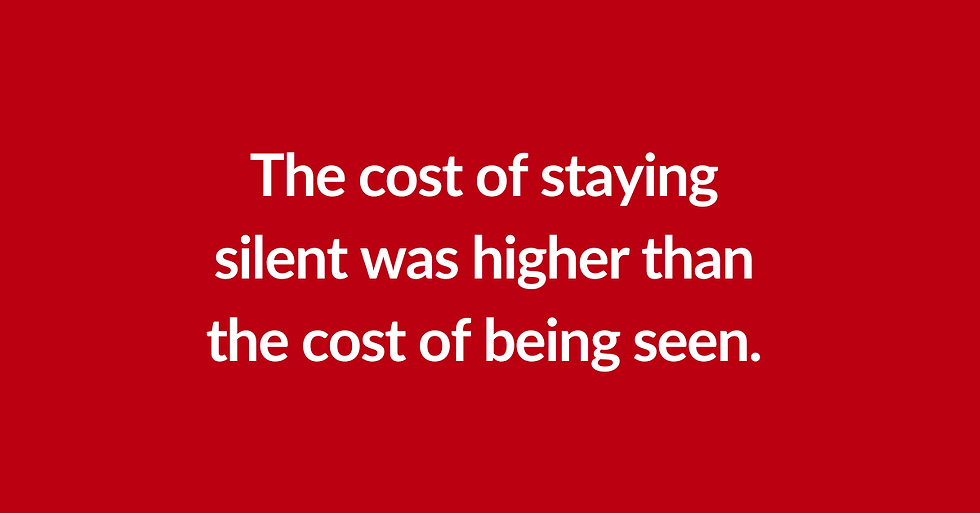
The cost of staying silent was higher than the cost of being seen.
That calculation, that specific calculation, is the thing I have spent thirty-three years trying to teach the women that worked for me and my clients and partners. Not confidence. Not bravado. Not the performance of certainty you don't feel.
The calculation.
What does it cost me to speak? What does it cost me to stay silent? Which cost is higher?
In my experience, women almost always underestimate the cost of silence and overestimate the cost of visibility. We have been trained by every institution we have ever moved through to believe that making ourselves smaller is safer. That staying quiet is protective. That waiting to be invited is the appropriate, professional, correct thing to do.
It is not safer. It is not protective. And the invitation is not coming.
The invitation was not coming for me in that White House Summit. I had to walk to the microphone myself. And everything that happened after: the job offer, the Congressional Hunger Center, twenty-five years of work that has mattered to me came from that one moment of courage. Of deciding that the cost of silence was too high.
HOW RADICAL ARE WE WILLING TO BE
I want to close with a question that has been living in my chest since I published the first edition of this series. One which a good friend posed to me.
Grassroots movements built this democracy. The people who showed up, organized, refused to accept that the powerful few got to decide everything that is the foundation.
Every right we have was won by someone who decided the cost of silence was too high.
Right now, that very impulse to represent people, to show up, to refuse to be erased is being called radical.
It is not radical. It is the whole point.
I am watching brilliant women in federal agencies, in corporations, in law firms and hospitals and technology companies, being told in ways subtle and not so subtle to make themselves smaller. To neutralize their language. To stop knowing so much. To stop speaking up.
And I am watching some of them comply. Not because they want to. Because they have been trained to believe that the cost of visibility is higher than the cost of silence.
It isn't.
I know this because I stood at a microphone at 28 years old with shaking legs and said the thing that needed to be said. And a man with a conscience heard me. And everything changed.
Your version of that moment is waiting.
Maybe it's not a White House Summit. Maybe it's a budget meeting. A performance review. A salary negotiation. A conversation you have been putting off for six months because the timing never feels quite right.
The timing is never going to feel quite right.
The question is: how radical are you willing to be?
If you're ready to find out, I'd love to be in the room with you.
On May 12th I'm hosting a free one-hour workshop called The Power of the Ask. It's for senior women leaders who are done waiting to be noticed and ready to ask for what they've already earned.
This piece is the why. The workshop is the how.
And if you want to go deeper, the Executive Presence Accelerator opens October 7th. A six-month program for senior women leaders who are ready to build the internal authority that makes everything we've talked about here feel not just possible but natural. Join the EPA Priority Notification List to be the first to know when registration opens.
Jen Coken is an Executive Leadership Coach, Author, and Speaker based in Annapolis, MD. She is the author of Make Imposter Syndrome Your Superpower and the founder of the Executive Presence Accelerator. www.jencoken.com
Comments